
CASE STUDY 04 · U.S. DEPARTMENT OF STATE / TRAVEL REIMBURSEMENT
Untangling a complex reimbursement journey
Mapped the traveler and auditor experience to reduce confusion, surface workflow breakdowns, and identify clearer paths to faster, more accurate reimbursement.
- Role
- Customer experience strategist; planned and led cross-functional CX engagement, and mapped the end-to-end reimbursement journey
- Scope
- Discovery, stakeholder facilitation, service blueprinting, recommendations
- Tools
- Stakeholder interviews · Journey mapping · Co-creation workshops · Workflow analysis
02 / Project snapshot
The project at a glance
- Organization
- U.S. Department of State
- Project type
- Service design, service blueprinting, CX project planning
- Timeline
- Discovery and blueprinting engagement; paused before implementation
- Team
- Travel policy leaders, auditors, product support staff, traveler representatives, CX team
- Primary audiences
- Federal travelers and the auditors who process their claims
- My role
- Customer experience strategist; planned and led cross-functional CX engagement, and mapped the end-to-end reimbursement journey
- Core challenge
- A reimbursement process that was hard to understand, easy to get wrong, and slow to correct
- Key focus areas
- Stakeholder alignment, journey mapping, service blueprinting, workflow analysis, transition planning
- Outcomes
- Transition-ready service blueprint and CX project plan with prioritized recommendations
03 / Problem
A reimbursement process that was hard to understand and easy to get wrong
Travelers sometimes had to personally purchase official travel and then request reimbursement through a process that was difficult to navigate. Unclear instructions, limited status visibility, missing documents, and disconnected systems created delays for travelers and extra manual work for auditors.
The agency needed more than a content refresh or a single workflow fix. It needed a shared, end-to-end view of the service so leaders could decide where to invest first.
| Problem | Why it mattered | Service design response |
|---|---|---|
| Instructions and required documents were unclear up front | Travelers often submitted incomplete claims without knowing it | Surfaced gaps in pre-submission content and guidance |
| Status and next steps were largely invisible | Travelers chased updates while auditors absorbed the questions | Mapped where status visibility broke between systems |
| Errors created rework on both sides | Small upstream gaps compounded into significant downstream effort | Connected traveler pain points to backstage auditor workload |
| Core systems did not share information | Manual workarounds replaced integration, slowing the service | Documented system dependencies and handoff breakdowns |
04 / My role
Leading a cross-functional CX engagement under ambiguity
I helped plan and facilitate a cross-functional engagement spanning travel policy, audit operations, product support, and traveler representatives. The work moved from an ambiguous "fix the experience" ask to a structured discovery, blueprinting, and recommendations effort.
My role was to keep the experience strategy honest, the stakeholder conversations productive, and the deliverables practical enough for leaders to act on.
I led
- • Problem framing and engagement scoping
- • Stakeholder interviews and synthesis
- • Workshop planning and facilitation
- • Current-state journey mapping
- • Frontstage and backstage service blueprinting
- • Workflow and system-dependency analysis
- • Prioritized recommendations and transition plan
I partnered with
- • Travel policy leaders
- • Reimbursement auditors
- • Product and support teams
- • Traveler representatives
- • CX colleagues across research and design
05 / Goal
Make the reimbursement service easier to navigate on both sides
The goal was not a single redesign, but a shared understanding of the full service that could guide content, process, and system improvements over time.
Anticipate
what is needed before travel.
Submit
a complete, accurate claim.
Track
status and next steps clearly.
Resolve
without repeated rework.
06 / Traveler and auditor journey
Mapping the reimbursement journey end to end
I mapped the experience around the four moments that mattered most to travelers and auditors, rather than the structure of the underlying systems.
Anticipate → Submit → Wait → Resolve
| Journey stage | Traveler need | Pain point | Design response |
|---|---|---|---|
| Anticipate | Understand what to do before travel | Guidance on required documents was scattered and unclear | Identified pre-travel content and expectation-setting gaps |
| Submit | File a complete, accurate claim | Travelers learned about errors only after submission | Recommended clearer instructions and inline validation |
| Wait | Know where the claim stands and what is needed next | Status updates were limited, inconsistent, or missing | Called for clearer status messaging and required-action prompts |
| Resolve | Get reimbursed without repeated back-and-forth | Auditors manually chased missing documents across systems | Mapped backstage rework patterns and improvement opportunities |
07 / Service blueprint
Connecting the visible experience to the system behind it
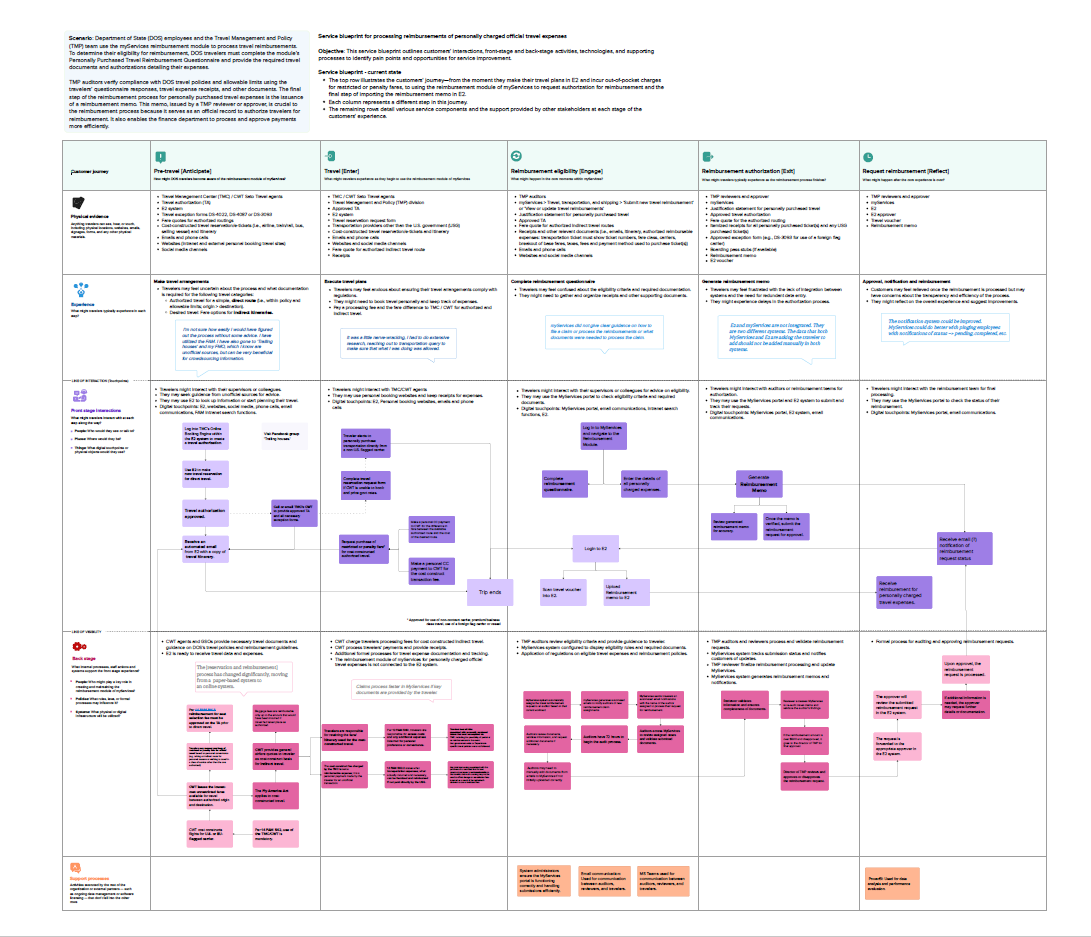
The blueprint layered traveler actions, service touchpoints, frontstage interactions, backstage workflow, system dependencies, and support processes onto a single view of the reimbursement journey.
The artifact below is a redacted portfolio view of the working blueprint used to align policy, audit, product, and support stakeholders. Agency-identifying details and internal tool names have been removed.
What travelers saw
- • Pre-travel guidance and forms
- • Submission portal and required documents
- • Status updates and notifications
- • Help and support touchpoints
What tied it together
- • Eligibility and policy rules
- • Handoffs between traveler, auditor, and system
- • Status and exception messaging
- • Data shared across tools
What teams managed
- • Audit review and compliance checks
- • Document chasing and rework
- • Reimbursement memo generation and approval
- • Manual workarounds across disconnected systems
08 / Strategic decisions
How I moved the work from ambiguity to action
Decision 01
Framed the problem before researching
Problem it solved: Leaders had different views of what success looked like.
Result: Aligned travel policy, audit, product, and support leaders on shared goals, scope, and success signals.
Decision 02
Brought traveler and auditor voices into the same room
Problem it solved: Frontstage and backstage perspectives were typically discussed in isolation.
Result: Stakeholder interviews and co-creation sessions exposed where the two experiences pulled against each other.
Decision 03
Blueprinted frontstage and backstage together
Problem it solved: Pain points looked isolated when viewed only from the traveler side.
Result: A unified blueprint revealed how content gaps, workflow steps, and disconnected systems compounded into delays.
Decision 04
Translated insights into prioritized recommendations
Problem it solved: Leaders needed practical next steps, not a long list of observations.
Result: Sequenced quick wins, process improvements, and longer-term system changes by impact and feasibility.
Decision 05
Built the blueprint to be transition-ready
Problem it solved: The work needed to remain useful if the engagement paused or changed hands.
Result: Documented assumptions, sources, and open questions so a future team could pick the work up without losing context.
09 / Transition-ready recommendations
A practical roadmap leaders could pick up and act on
The recommendations were sequenced so the agency could act on quick wins immediately while planning for the process and system changes that would take longer.
First
Simplify traveler instructions and required-document guidance
Rewrite traveler-facing content in plain language, organized around the steps a traveler actually takes.
Then
Add clearer status updates and required-action messaging
Surface where a claim stands, what is needed next, and who is responsible at each step.
Then
Improve data collection on bottlenecks and recurring errors
Capture lightweight signals across the workflow so leaders can see where the service breaks down and why.
Later
Use the blueprint to prioritize system and process investments
Sequence content fixes, process improvements, and integration work against impact, effort, and risk.
10 / What I delivered
A transition-ready blueprint and CX project plan
The engagement paused before implementation, so this case study does not claim post-launch metrics. The deliverables themselves were the outcome: a clear, shared view of the current-state service and a practical plan leaders could carry forward.
- End-to-end current-state service blueprint covering frontstage and backstage
- Synthesized stakeholder insights from travelers, auditors, policy, and support
- Prioritized recommendations across content, process, and systems
- CX project plan with sequencing, dependencies, and open questions for transition
11 / Reflection
What I took from this work
Lesson 01
Ambiguity is the work, not a blocker
Framing, alignment, and shared language did more for the engagement than any single research artifact. Clarity upstream made every downstream decision faster.
Lesson 02
Service design makes invisible work visible
Backstage auditor effort was the hidden cost of upstream content and system gaps. The blueprint made that tradeoff legible to leaders who only saw one side.
Lesson 03
Transition-ready beats final
A blueprint that documents what is known, what is assumed, and what is still open is more useful to leaders than a polished deliverable that hides its seams.