
CASE STUDY 03 · GSA / HR LINKS
Beyond conversion
Modernized 125 aging, non-compliant HR files ahead of a fixed migration deadline, delivering accessible, plain-language guidance for federal clients and 17K+ GSA employees.
- Role
- Content strategy and modernization lead
- Scope
- Discovery, governance, HTML conversion, accessibility, stakeholder adoption
- Tools
- Drupal · Siteimprove · Mural/Miro · Google Analytics · Mouseflow
- 125Assets consolidated
- 80–90%Engagement rate
- 100%Accessibility requirements met
02 / Project snapshot
The project at a glance
- Organization
- U.S. General Services Administration / HR Links
- Timeline
- 4 months (first phase) / 2024
- Team
- HR stakeholders, content owners, technical team, accessibility reviewers, communications partners
- Project type
- Legacy content modernization, accessibility remediation, content design
- Primary audience
- Federal employees, HR stakeholders, content owners, service teams
- My role
- Content strategy and modernization lead. Managed discovery, governance, HTML conversion, accessibility, and stakeholder adoption
- Tools
- Drupal, Siteimprove, Mural/Miro, Google Analytics, Mouseflow, PDF/HTML review tools
- Core challenge
- Replaced aging, non-compliant HR files before a fixed migration deadline
- Outcomes
- Improved access, reduced content risk, stronger publishing standards, measurable engagement
03 / Problem
A dying server, critical legacy files, and a non-negotiable deadline.
The project began with an urgent operational risk: a legacy server was being decommissioned while critical HR guidance remained in static PDF files that were difficult to maintain, search, update, and make accessible.
A simple file migration would have transferred existing problems to a new location. The greater challenge was guiding stakeholders to adopt a publishing model that prioritized accessibility, usability, and long-term content quality.
This was more than a content conversion project. It was a change management and content modernization initiative to help teams adopt new standards, reduce compliance risk, and provide employees with more reliable HR guidance.
| Problem | Why it mattered | Design response |
|---|---|---|
| Legacy files were non-compliant or difficult to maintain | Employees and teams could not rely on consistent access | Converted priority files into accessible HTML |
| Content was scattered across static documents | People had to dig through dense files to find answers | Created clearer page structures and navigation |
| Deadline was fixed | The team had limited time to remediate high-risk content | Used a phased prioritization plan |
| Content owners had inconsistent publishing practices | Problems could return after migration | Created reusable standards and workflows |
04 / My role
Leading content modernization across three workstreams
I managed discovery, governance, and conversion workstreams to transition the project from emergency migration to sustainable content modernization.
I used a phased communication approach to help stakeholders view the shift from static PDFs to structured HTML as a better publishing model that is easier to use, maintain, and monitor for accessibility and quality. That framing supported smoother adoption and stronger post-launch performance.
I led
- • Content inventory and prioritization
- • Stakeholder discovery and alignment
- • Accessibility review and remediation planning
- • PDF-to-HTML conversion strategy
- • Plain-language restructuring and content cleanup
- • Publishing standards and reusable patterns
- • Quality assurance and monitoring
- • Coordination across HR, technical, accessibility, and communications teams
I partnered with
- • Agency stakeholders responsible for HR content policy and publishing
- • Product and technical teams
- • Accessibility and compliance reviewers
- • Digital communications teams
- • Account management team for interagency Presidential and Congressional Commissions and Boards Services
05 / Goal
Make HR guidance easier to find, use, and maintain
The goal was not just to move files before the server deadline, but to build a sustainable HR content system that helped employees find relevant guidance and gave internal teams a way to maintain compliant, accessible content over time.
Find
guidance employees need.
Understand
what the requirements mean.
Take action
with confidence and clarity.
Trust
the content is current.
06 / Employee journey
Mapping the employee support journey
I mapped the experience based on employees' needs with HR guidance, rather than the structure of legacy files.
The redesign answered a core question: how could employees quickly find accurate HR guidance, understand what applied to them, and complete the next step without relying on inaccessible files or outdated links?
Find guidance → Understand requirements → Take action → Return to current content
| Journey stage | Employee need | Pain point | Design response |
|---|---|---|---|
| Find guidance | Locate the right HR resource quickly | Content was buried in static files and legacy links | Consolidated and organized priority resources |
| Understand requirements | Know what a policy, benefit, or process means | Dense PDF content created reading and accessibility barriers | Converted key content into structured HTML |
| Take action | Complete the next step confidently | Instructions and links were inconsistent | Added clearer hierarchy, labels, links, and calls to action |
| Return later | Trust the information is current | Legacy files were difficult to update | Created maintainable publishing patterns and monitoring |
07 / Service blueprint
Connecting employee needs to the system behind the content
The work aligned the employee experience with the internal systems needed to keep HR guidance accessible, accurate, and maintainable.
What employees saw
- • HR guidance pages
- • Accessible HTML content
- • Clearer page hierarchy
- • Improved labels and links
- • Searchable resources
What tied it together
- • Content inventory
- • Prioritization model
- • Reusable page patterns
- • Accessibility standards
- • Review workflow
What teams managed
- • Legacy file migration
- • Content owner approvals
- • Accessibility remediation
- • Publishing governance
- • Monitoring and maintenance
This approach shifted the project from emergency conversion to a sustainable content operating model.
08 / Design decisions
Design decisions that reduced risk and improved access
Decision 01
Prioritized high-risk content first
Problem it solved: The team could not convert everything at once before the server deadline.
Result: Critical HR resources were addressed first, reducing operational and compliance risk.
Decision 02
Reframed accessibility as a business requirement
Problem it solved: Accessibility could have been treated as a final compliance check instead of a core service requirement.
Result: Section 508 and WCAG require a structured content model, publishing standards, and QA from the start.
Decision 03
Converted static files into structured HTML
Problem it solved: PDFs and legacy files were hard to search, update, and use with assistive technology.
Result: Employees had more accessible, scannable, and maintainable HR resources.
Decision 04
Created reusable content patterns
Problem it solved: HR content was inconsistent across pages and owners.
Result: Teams could publish updates more consistently after launch.
Decision 05
Used a minimalist design approach
Problem it solved: Employees needed quick answers, not decorative complexity.
Result: The redesigned pages focused attention on essential guidance, links, and next steps.
09 / Before and after proof
Three paired examples
Legacy files to accessible HTML
Why it matteredEmployees could find guidance faster, and teams could maintain updates without recreating legacy file problems.
Role-based lists to task-based guidance
Why it matteredEmployees could scan for the right action by role and task instead of reading through long link lists, and content owners had a reusable pattern to maintain.
Static job aid page to structured self-service
Why it matteredEmployees found self-service tasks faster, and the page met Section 508 and WCAG requirements without rework.
09b / More redesigned pages
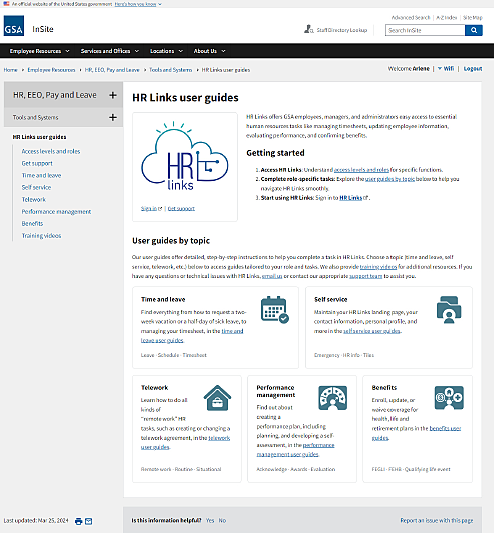
Consistent patterns across the new HR Links
Beyond the initial improvements, the same accessibility-first patterns were applied to high-traffic pages employees use every pay period, including timesheets, benefits, and training videos.
10 / Impact
Federal-grade outcomes, employee-grade ease.
The project reduced operational risk, improved employee access to HR guidance, and provided internal teams with a more sustainable way to manage high-value content.
Metrics are based on post-launch analytics, content inventory tracking, accessibility review, and performance monitoring across priority HR Links resources.
Engagement across redesigned HR resources
Lower bounce rates across priority pages
Accessibility requirements met
Section 508/WCAG-aligned review, remediation, and monitoring.
HR assets consolidated and modernized
11 / Reflection
What I learned
Lesson 01
Conversion is not modernization
Moving content alone is not sufficient. Without improvements to structure, accessibility, and maintenance, the same problems persist in the new system.
Lesson 02
Accessibility is an operational strategy
Accessibility is not only a legal requirement; it also reduces risk, improves employee access, and makes services easier to maintain.
Lesson 03
Sustainable content needs governance
A better page addresses only the immediate issue. Reusable patterns, review cycles, and monitoring ensure the service remains usable after launch.